Saturday, September 3, 2011

Cylinder Deactivation: Best of both worlds


Cylinder deactivation or variable cylinder management systems, as the names imply, control the number of cylinders in use by the engine. This technology has been used by big displacement motors, like Honda Accord's 3.5l V6, to reduce fuel consumption. It has also been used in hybrid’s like the Civic Hybrid to shut off the engine when running in electric mode or during braking.


The cylinder de-activation system monitors the driving conditions and when it senses that the full torque of the engine is not required it shuts off fuel and air from entering a pre-decided cylinder/s. So what happens? The piston inside the cylinder keeps moving up and down. But now it experiences very little load as the trapped inside air acts as a spring that pushes against the piston when it is compressed. The ECU also cuts off the fuel supply to the cylinders. The use of this system has pitfalls - such as resonance and mechanical imbalance. Manufacturers have found different ways of working around these using active acoustics to control drone and active engine mounts to absorb vibrations.

However, Volkswagen has just announced the use of this system on a turbocharged, 4-cylinder in-line motor. During low load conditions the 1.4 TSI motor will "switch off" the 2nd and 3rd cylinders by keeping the intake and exhaust valves closed. The two active cylinders will now run at higher loads and this improves efficiency.  This is done when the motor is running between 1,400 and 4,000 rpm and its torque is between 25 and 75 Nm. VW claims that these parameters apply to nearly 70 per cent of European driving distance in the EU driving cycle. The cylinders then spring back to life as soon as the driver presses the accelerator pedal hard enough. Notably, here the engine runs either in 2 cylinder or 4-cylinder mode. Watch the video to understand how it works.  


The Accord in comparison can go from 6 to 4 and even down to 3 cylinders. However, the I4 motor's by sticking to 2-cylinder or 4-cylinder operation will keep vibrations and harshness under check. Turbocharged fours are the next wave across classes of cars so you can expect the 1.4TSI with cylinder de-activation to power a wide range of cars in the VW family. The engine is expected to debut in 2012.

Friday, September 2, 2011

LASER up your car!

It’s always interesting to see new technologies in cars. BMW were technology and design trail blazers dues to the corona rings used in headlights.  It created a striking, unmistakable identity for all BMW products and gave them a "wow" factor as well. Now, BMW is looking at taking that to an all new level with LASER lights! Think LASER and you think a KAPOW!! KAPOW!! KAPOW!! Well not this time.

This time LASERS will only ZAP away darkness. Yes, LASER light is powerful, thousand times more powerful than LEDs. That's because - a Laser cell generates 170 Lumens of brightness compared to an LED cell, and on top of that it is much, much smaller. You can pack a 100 LASER cells in the space occupied by a single LED cell. So what you get is intense, bright well behaved light. Well behaved - because Laser light doesn’t radiate outwards. Remember Star Wars? LASER light shoots straight, it doesn’t spread out as the beams travel parallel to each other. Which means it will be possible to create very specific light patterns, which will be a big help for different speeds, oncoming traffic and cornering lights.


Now you won’t be able to use these lights as weapons... I know what a shame. Imagine pressing the high beam switch to “blind” that oncoming truck. Anyway, evil thoughts aside, it isn't possible because it isn't raw laser light that will shoot out of the head lamps. A fluorescent phosphor material will convert the bluish laser light into a bright white light, which will be safe for human or animal eyes.

Other than improved safety thanks to better visibility Laser will also improve fuel efficiency as it consumes even lesser energy than LEDs. Also, LASER cells will allow designers greater freedom with packaging the front end, so how cars look will also change. Although BMW insist that the "eyes" won’t be made smaller, how that space is used will change. And who knows, maybe laser light will replace LEDs on the inside of cars too. 

So let’s see when LASER tech gets to us. BMW's says it is a "few years" away.
:-|

.. couldn't resist. :-)


Star Wars wallpaper from arts-wallpapers.com , Star Wars shot from dailymail.co.uk

Wednesday, August 31, 2011

How much Horsepower you have man?


 Today it’s easy to forget how incredible automobiles are. Like the Iron Man’s suit these machines give us abilities that exceed the limits of our flesh and bone. Yet we don’t think of our cars or bikes as anything special. We take them for granted. I look contemptuously at 7 bhp scooters – categorise them as tame runabouts. Anything to be worthy of respect needs to have at least 30bhp on two-wheels and around 100bhp in cars. That’s my internal scale. Yours might be different. For instance, serious respect/fear is commanded by 100/350bhp at the very least.

Ask any motorcyclist what he loves so much about being on a bike – he’ll say “Freedom!” That freedom, at least partly, is the freedom from the physical limitations of the body. Usain Bolt’s fastest been clocked doing 37.5kph over 100 metres. On a bike, we all know how much faster and how much longer we can keep going.  Your bike makes you a SuperSomething. That’s the Power of BHP. The same applies to cars. It is just that, in a car, the sensation is a bit muted and not quite as immediate and satisfying as on a motorcycle. With your super power you can flatten slopes, re-define distances and your own abilities .


We find more ways of enjoying our super-abilities. Weekend rides are quite popular with bikers. Hilly sections are the most satisfying. That’s because when you get to the top the sense of achievement is similar to what you would feel if you would have trudged all the way to the top on your own two feet. Then one day, my nephew who is an avid cyclist (he puts in more kilometres training on his Orbea every morning than I commute by car/bike in a day) asked me, “What do you get out of it?” I gave him the whole shebang about man and machine, finding the limits and controlling the power of the machine. He didn’t seem to get any of it (he doesn’t have a drivers/riders license yet) and dismissed me as a polluting looney bin.


But the thing is that I also cycle and understand where he’s coming from. To climb those hills using personal horsepower tests your commitment and ability completely. The first trip ensured that my appreciation for every BHP generated by even the ordinary 7-bhp-machines went up exponentially. You stop thinking of that power as just a silly tap that you can turn on and off. Every time a bike passed me, its throttle snapped all the way back, the rider trying to eke an extra kph out of the already strained motorcycle, I promised myself that I would never do that, again. Suddenly I could empathise with the machine. On that day and on subsequent rides, one question would loom in my mind - how much horsepower do I make?


Somewhere in there you'll find your BHP count.

Well, the answer came to me at the gym this morning. Hop on to one of those elliptical trainers or cycles and pedal away as furiously as you want. Most of the new gym equipments have a display for energy being generated– it’s shown in Watts. Make a mental note of that. To convert it to BHP just multiply the number by 0.0013. The elliptical trainer depressed me a fair bit as it showed a peak output of 38W which equals 0.0494bhp (low intensity warm up phase)! I felt a lot better when I upped the intensity on the cycling machine.  I registered a peak output of 188W (briefly)– which equals to a dazzling 0.244bhp!
All I know is  every time I get on my bike I’m going to enjoy every BHP, no matter how little.


Image source: BMW K1600GT from Autocarindia.com & Exercise machine display from Lifefitness.com


Monday, August 29, 2011

Dr Felix Wankel's Dream


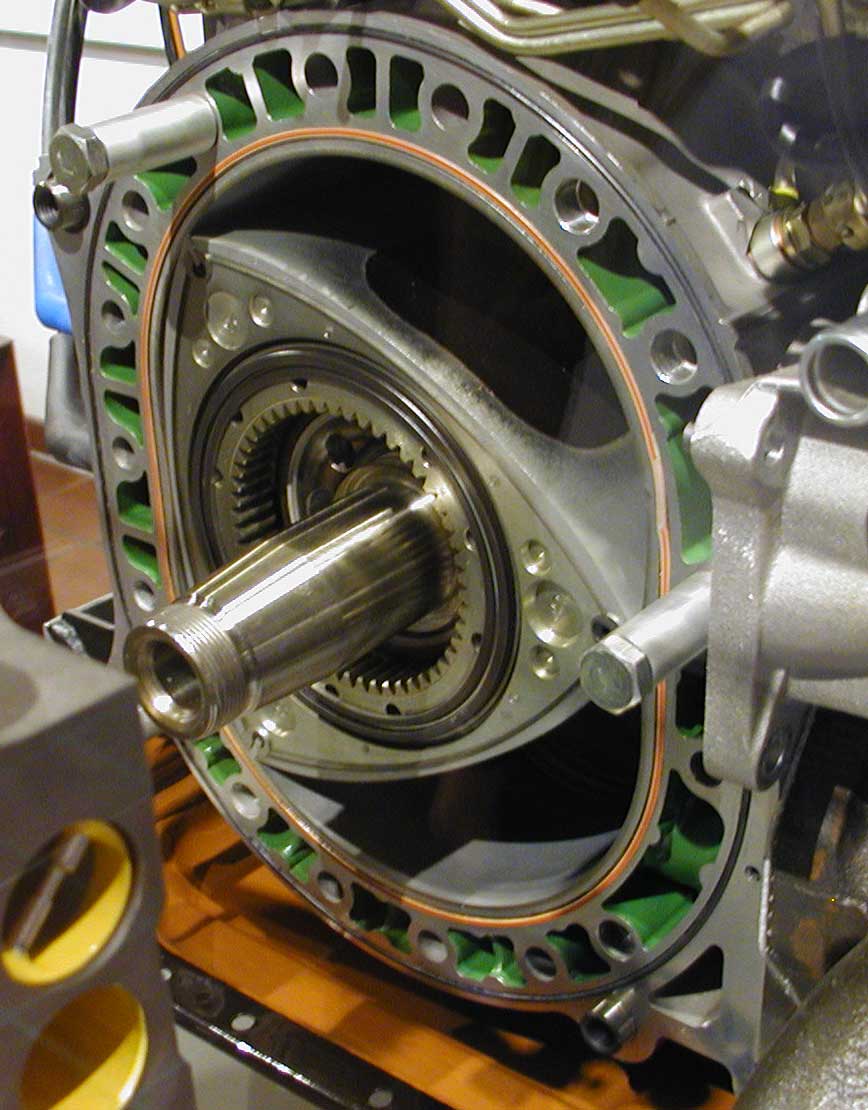
Innards of a Wankel engine

First and foremost credit to German designer – Dr Felix Wankel. Though he was only 17 years old when the idea first came to him, and that too in a dream! He persevered and eventually turned the dream intoa reality. In 1957, nearly forty years later, the rotary engine was born. FYI – In early versions of the motor even the jacket used to rotate!

What made it so cool?
Well unlike the traditional engines the Wankel engine didn’t have any pistons or parts moving up and down. Instead it has rotors doing the job of pistons and they rotate around a horizontal axis. Simply put (!!), instead of the reciprocating motion of pistons it is the rotational motion that provides power.  This makes it more a efficient design and gives the engine its free-revving, ultra responsive nature. It also has fewer moving parts. There is no valve gear – which means it is simpler and less likely to fail. It is also less likely to shut down straight away, instead it is more likely will have a drop in performance, but will continue running.  It is also a very compact.

Wankel engine in operation.


How was it different in design?
I’m over simplifying here. In a Wankel engine there are no cylinders as we nknow them, or pistons. There is no complex valve operating mechanism either. There is no funkily shaped crankshaft either. Its a different world. First think of the block here as a “wide-waisted figure of eight”. Or a pinched in-the-middle oval shape. This is where the action happens and its formally known as the rotor housing. At the centre of this space is a triangle with its tips touching the cylinder. This is the rotor or “piston”.
Now, think of the three areas created between the tips as independent rooms where work is happening. These are the “cylinders”. One room does one task only. So the first room has a door leading into it. This is the intake port. Through it the fresh air is drawn in. The next room is responsible for compression. The compression space morphs a bit and becomes responsible for the power stroke. Then the last room has a “door” or port for the exhaust. All the rooms are working in parallel. And its the rotor that keeps moving the air from one room to the other. The triangle/rotor isn’t exactly a triangle – its like a puffy triangle and this along with its eccentric movement creates a vacuum to suck the air in, then compresses it and then creates space for the exploding fuel and then finally pushes it out.
Whew.
As the power stroke pushes the rotor it also turns the shaft at the centre that is connected via a planetary gear (on an eccentric lobe – basically it sticks out on one side - this is what lets the rotor move around while keeping the three tips in contact with the surface at all time). This is how the power is transferred, and that makes the eccentric shaft, the crank shaft. Simple? 

So how do you measure displacement of a Wankel engine?
Good question. Since all three spaces are working simultaneously do you measure all three? 
NO you do not measure all three. There are different ways of doing it. A commonly accepted way is to measure the difference between the maximum and minimum volume of one chamber. That displacement then gets multiplied by the number of rotors.

Some cool facts:
1)      A two rotor Wankel engine’s power stroke can be compared to a conventional 6-cylinder motor! That’s because the power phase lasts that long!
2)      To compare a Wankel rotor with a regular piston engine the piston engine will have be twice its size. After all the piston experiences a power stroke every other cycle while a rotor experiences a a power stroke every rotation!
3)      For every rotation of the rotor, air-fuel mixture is drawn in and burnt gasses are expelled three times!
4)      The heat load is unequal in a Wankel engine’s “block” – one side will be hot, another side cool.
5)      It’s got no intake or exhaust valves!


Specifically about the RENESIS motor from Mazda RX8:
1)      Ports: It has three intake ports and two exhaust ports. Each intake port has its own manifold. The control of intake ports can tailor the engines torque curve.
2)      Injectors: Each intake port also has its independent injector.  Each injector has different number of orifices.
3)      Spark plugs: Due to the longish shape of the combustion chamber the Wankel motor uses two spark plugs. Both work independently. One is the leading plug and the second plug comes further in the direction of rotation.   

So what was the problem?
The seals – the tips of the rotors needed to be spectacularly resistant to friction and pressure. It took time to develop a system that would help them last. The engine as such tends to consume more oil and fuel and proves to be thirstier compared to reciprocating engines of equivalent displacement.
The combustion chamber shape itself isn’t optimal. Its very long.
And the highish position of the output shaft leads to some design issues as well. 

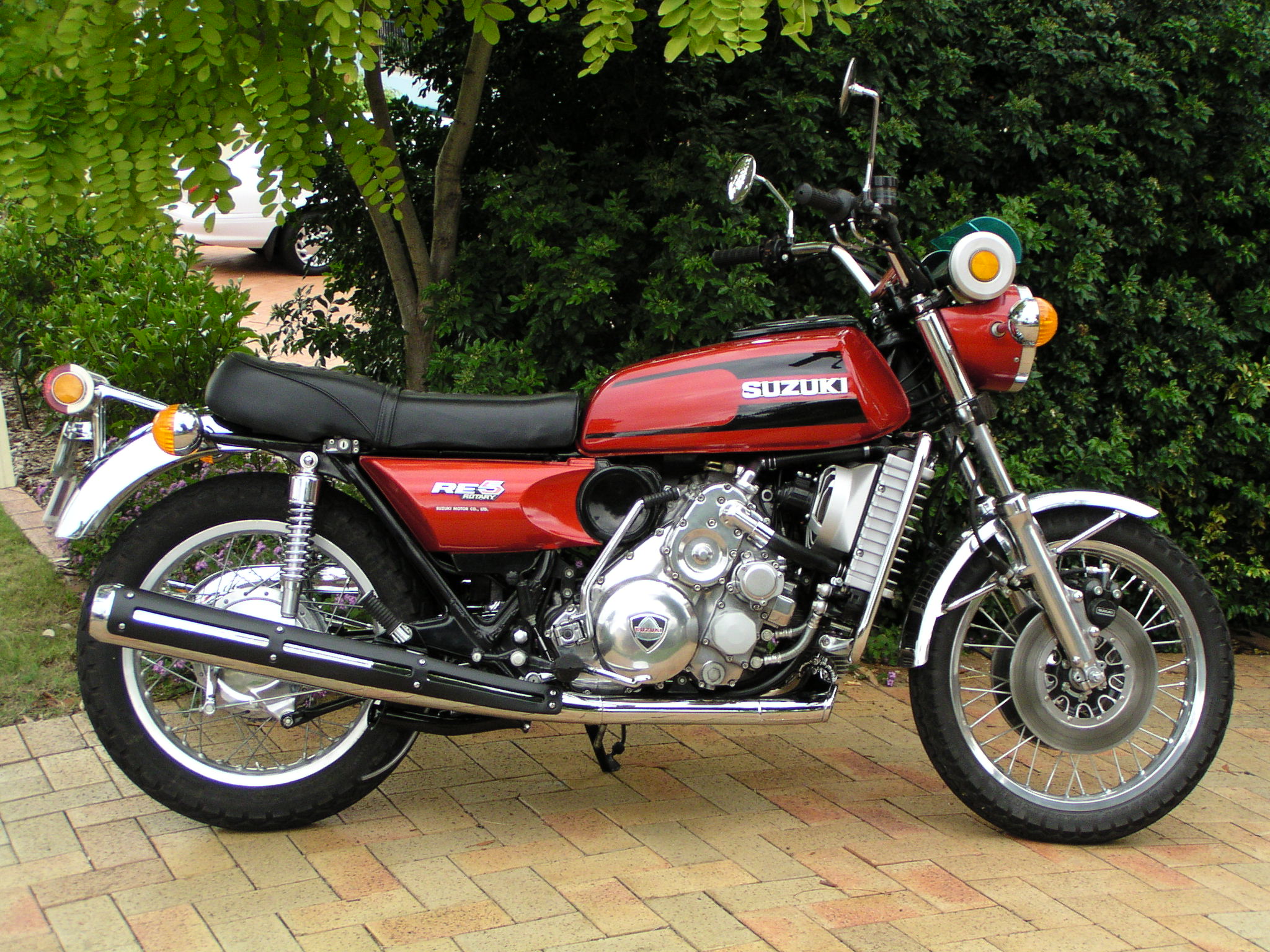
Suzuki's RE-5 rotary engined motorcycle was launched in 1974.

Even though several manufacturers gave a shot at the Rotary engine only Mazda persisted with the technology. It seems strange that it’s weak points couldn’t be fixed, in the light of its advantages. Maybe it was because that the Rotary engine didn't lend itself well to diesel fuel as well that manufacturers didn’t see any point in putting too much effort to develop the design further. However, the MAZDA site talks of the hydrogen powered rotary engine and its advantages. 

Despite news of the RX8's phase out, hopeffully Mazda has plans to give this engine a new lease on life in the future.
Explanation and details gleaned from – Bosch Automotive Handbook 7th Edition, AA The Book of The Car, Wikipedia, Mazda & prelovac.com. Images from Wikimedia Commons: Gtregs75 & Softeis!  Gif from prelovac.com. Many thanks! Head on over to these sites to knock yourself silly with many more details on the Wankel engine.

Saturday, August 27, 2011

Cole Trickle moves up to a Red Bull F1 car

Finally it is F1 time once again. Suitably there is an F1 related video taht you have to watch. Tom Cruise loves cars and loves driving them fast. His old movie Days of Thunder was inspired from that very passion. He's proved himself to be an apt racer not just on celluloid but even in the real world. He's spent a lot of time at race tracks and is extremely competitive, spare-no-quarter, burn-the-midnight-oil type of guy.

So when Red Bull offered him a chance to drive David Coulthard's F1 car, as they say, he was there! While this news was out a few days back, the video wasn't. So Tom turned up at Willow Springs, Texas (Next year's American Grand Prix is going to be in Austin, Texas remember?) and went through a quick briefing session about the nuances of driving an F1 car with DC before heading out.  Anyhow, Tom went out and did many laps, proved himself to be methodical, and quick. And also, human - he had a bit of an off-road adventure. As if driving at over 300kph wasn't enough he then rolled and looped .. no not the F1 car.. a helicopter that was on hand. Catch all of that in the vid right here..


Nice one Cole.. 

Wednesday, August 24, 2011

BMW's X3 to be unveiled, Audi launches pre-emptive strike

BMW's new X3, now in India

Today BMW will unveil their next generation X3. The previous vehicle didn't fare well in the Indian market, so its a good thing that the new X3 is a different creature. It is bigger, softer, more comfortable and well.. less unattractive than the outgoing vehicle (this is palatable if somewhat cold), so  it should do much much better. BMW has been very aggressive with their Indian products offering them at cracking prices while offering good levels of features. And, they surely intend to do the same with the X3.

This however doesn't sit too well with Audi. After all their Q5 is the king of the mid-size premium SUV market. So Audi tried to steal some of the X3's thunder. They recently announced the Q5 2.0TDI q Business Edition at a very attractive Rs35.13 lakh ex-Maharashtra and will be quite a temptation for those looking at the upper end of the compact luxury saloons or even the lower  rung of  the bigger luxury cars. While I look foward to new engines to drive, the announcement did make me raise my eyebrows when i read that the Q5 will be in showrooms only from October. Naughty Audi.
Audi's Q5 is hotter of the two

Coming back to the cars,  it will be a close match. On paper, the BMW has an advantage - the engine develops more power and torque, and it also has an extra cog in the gearbox (8 to Audi's 7). While I don't have the final list of standard vs optional equipment Audi has mentioned "best-in-class infotainment system", Audi's MMI and parking aid. So lets see what all the companies offer by way of equipment on these two. Bit, will BMW deliver a knock out punch with the X3's price tag?
Well we'll come to know this afternoon.

Well here is the update after the X3 Launch

BMW has launched the X3 at Rs 41.2 Lakh for the X-Drive2.0d. The 258bhp X-Drive3.0D is priced at Rs 47.9L. In the light of Audi's new Q5 pricing it seems a bit exorbitant. But when you look closer it falls into place. The X3 comes loaded with the massive panoramic sun-roof and Dynamic Drive and Damper Control as standard. Apart from this it has extra bits of tech like Auto Start-Stop.  So these bits have added to the cost of the X3. No confirmation yet whether Audi's Q5 has anything extraordinary features as standard, assuming that the standard fare is the usual stuff mentioned in the press release.

So, will BMW bring in a bare basics X3 anytime soon? Not likely. BMW insist that they are a premium player and so is the X3, which is why a stripped down model doesn't make sense, at least for now. BMW didn't bring the Corporate Edition of the 3-Series later on in its life-cycle. That is when additional demand needed to be generated. Right now, BMW feels the demand for the X3 exceeds supply. Vishal Agarwal of Bavaria Motors has confirmed that they have had pre-launch bookings. BMW is looking to sell 100 units of the X3 every month. Audi sold 150 units of the Q5 & Q7 combined in July. So 100 units is still a fairly aggressive number.  I guess we'll just have to wait and watch.


All images from Autocarindia.com

Tuesday, August 23, 2011

Ferrari's proper new Ferrari and a New Porsche

What are the chances that on the same day that Ferrari reveals the F458 Spider that Porsche also uncovers the all-new 911 Carrera?!!

The reason these cars caught my attention, more than the amount usually reserved for a Ferrari or a Porsche, is because of two separate reasons.
One - The Italia now really looks like a Ferrari.
Two - The Porsche while still looking like a Porsche, actually looks different.

Let me elucidate. First, the Ferrari.


When you said Italian there was a certain sexiness that you expected. Something with character, a bit flamboyant, confident and elite. Something that you would look at and promise yourself that you would have it someday (or at least have a ride in if not see in the flesh - depending on your age and drive... :-)). You could rip a badge of most Ferraris and people would still recognise the craft of Maranello. The versatile F355, the flawed F50 and the stunning Testarossa despite their shortcomings are perfect examples of Ferrari-ness. I dub them “Recent Classics”. In the past few generations only the F430 has lived up to the Ferrari name.

I imagine being quick for a Ferrari is important, and being quickest is the ultimate goal, but at what expense? At the expense of making the super cars look like cartoon cars brought to life. I can easily imagine the Italia in the next Cars edition. Its roof line seems out of proportion and those eyes seem something Japanese designers thought of in the 80s. But now with the F458 Italia Spider balance has been restored. With the roof gone there is a beautiful, dramatic, familiar oh-I-gotta-have/sit/ride/see-this feeling. It is absolutely breathtaking! I can’t wait to see it in Frankfurt, for all the right reasons. The receding structures for roll over protection instead of pop out hoops or plain hoops add an almost playboyish element to it. I want to see the retractable aluminium hard-top in action.


Ferrari claims it takes fourteen seconds to make the switch and that the system weighs 25kgs lesser than previous folding soft tops. Nice. The open-top rocket ship retains its 4.5 litre V8 and Ferrari claims that 0-100 will come in under 3.4 seconds. Hmm, same as the coupe. Top speed though is down from 325 to 320kph. But with Ferrari saying - “the engine soundtrack has been honed to ensure that the car’s occupants are completely captivated by the drop-top driving experience” I wouldn’t care!! Now if only they’d do something about those fishy eyes.

Here's a teaser video of the Spider - theres a full video out as well but I like this one better.


Now, the Porsche.

I struggle to differentiate one Porsche from the other. I can’t tell between Carrera S, Carrera 4S, Carrera 4 Carrera GTS. The differences are such that it would take a microscope to pin point things. It’s no different when talking about successive generations of models. Luckily with the all new 911 Carrera, things are different. You look at the new Carrera and straight away you will be able to tell it apart from its predecessor. It feels hefty, bigger. There are also some new, obvious aggressive cues. The way the eyelets cut into the bumper and the way the fins in the airdam have been designed seem to hint at a younger Porsche. Is it a nudge from the company’s new owners?


Between the wheels the Porsche has grown too. The wheelbase is longer by a massive 100mm. But weight is down by 45kgs as thanks to extensive use of alumnium . The engine is in its traditional place slung over the rear axle and develops 350hp from its 3.4litres of displacement . Autocar points out that while engine size is down from 3.6 power is up, and so is efficiency as per Porsche's claims. The engine config is a flat six. The Carrera S (pictured above) will feature a 3.8litre flat six motor developing 400hp. Which will propel it from 0-100 in 4.3 seconds. Apart from the PDK twin-clutch automatic gearbox, the Carrera will also debut with a world first - seven-speed manual transmission!! Coming back to the design the rear been significantly remodeled while keeping Porsche heritage intact. The rear looks muscularly handsome with slinky tail lights pointing outwards . It is a very smooth shape and the cut out for the number plate mirrors the airdam at the front very neatly. Incredible stuff.

Now, the only thing remaining to figure out is which one of these will be my desktop wallpaper. Tough one!

Photos from Autocarindia.com & Autocar.co.uk