 |
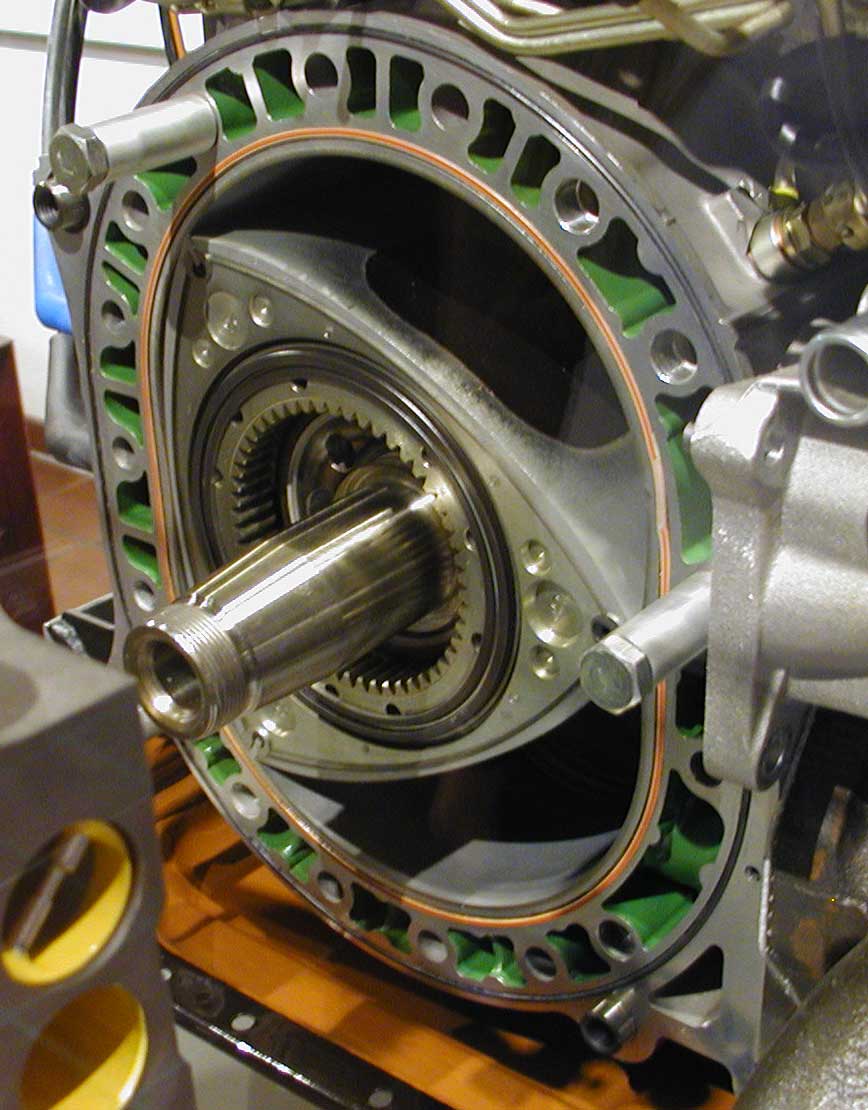
| Innards of a Wankel engine |
First and foremost credit to German designer – Dr Felix Wankel. Though he was only 17 years old when the idea first came to him, and that too in a dream! He persevered and eventually turned the dream intoa reality. In 1957, nearly forty years later, the rotary engine was born. FYI – In early versions of the motor even the jacket used to rotate!
What made it so cool?
Well unlike the traditional engines the Wankel engine didn’t have any pistons or parts moving up and down. Instead it has rotors doing the job of pistons and they rotate around a horizontal axis. Simply put (!!), instead of the reciprocating motion of pistons it is the rotational motion that provides power. This makes it more a efficient design and gives the engine its free-revving, ultra responsive nature. It also has fewer moving parts. There is no valve gear – which means it is simpler and less likely to fail. It is also less likely to shut down straight away, instead it is more likely will have a drop in performance, but will continue running. It is also a very compact.
 |
| Wankel engine in operation. |
How was it different in design?
I’m over simplifying here. In a Wankel engine there are no cylinders as we nknow them, or pistons. There is no complex valve operating mechanism either. There is no funkily shaped crankshaft either. Its a different world. First think of the block here as a “wide-waisted figure of eight”. Or a pinched in-the-middle oval shape. This is where the action happens and its formally known as the rotor housing. At the centre of this space is a triangle with its tips touching the cylinder. This is the rotor or “piston”.
Now, think of the three areas created between the tips as independent rooms where work is happening. These are the “cylinders”. One room does one task only. So the first room has a door leading into it. This is the intake port. Through it the fresh air is drawn in. The next room is responsible for compression. The compression space morphs a bit and becomes responsible for the power stroke. Then the last room has a “door” or port for the exhaust. All the rooms are working in parallel. And its the rotor that keeps moving the air from one room to the other. The triangle/rotor isn’t exactly a triangle – its like a puffy triangle and this along with its eccentric movement creates a vacuum to suck the air in, then compresses it and then creates space for the exploding fuel and then finally pushes it out.
Whew.
As the power stroke pushes the rotor it also turns the shaft at the centre that is connected via a planetary gear (on an eccentric lobe – basically it sticks out on one side - this is what lets the rotor move around while keeping the three tips in contact with the surface at all time). This is how the power is transferred, and that makes the eccentric shaft, the crank shaft. Simple?
So how do you measure displacement of a Wankel engine?
Good question. Since all three spaces are working simultaneously do you measure all three?
NO you do not measure all three. There are different ways of doing it. A commonly accepted way is to measure the difference between the maximum and minimum volume of one chamber. That displacement then gets multiplied by the number of rotors.
NO you do not measure all three. There are different ways of doing it. A commonly accepted way is to measure the difference between the maximum and minimum volume of one chamber. That displacement then gets multiplied by the number of rotors.
Some cool facts:
1) A two rotor Wankel engine’s power stroke can be compared to a conventional 6-cylinder motor! That’s because the power phase lasts that long!
2) To compare a Wankel rotor with a regular piston engine the piston engine will have be twice its size. After all the piston experiences a power stroke every other cycle while a rotor experiences a a power stroke every rotation!
3) For every rotation of the rotor, air-fuel mixture is drawn in and burnt gasses are expelled three times!
4) The heat load is unequal in a Wankel engine’s “block” – one side will be hot, another side cool.
5) It’s got no intake or exhaust valves!

Specifically about the RENESIS motor from Mazda RX8:
1) Ports: It has three intake ports and two exhaust ports. Each intake port has its own manifold. The control of intake ports can tailor the engines torque curve.
2) Injectors: Each intake port also has its independent injector. Each injector has different number of orifices.
3) Spark plugs: Due to the longish shape of the combustion chamber the Wankel motor uses two spark plugs. Both work independently. One is the leading plug and the second plug comes further in the direction of rotation.
So what was the problem?
The seals – the tips of the rotors needed to be spectacularly resistant to friction and pressure. It took time to develop a system that would help them last. The engine as such tends to consume more oil and fuel and proves to be thirstier compared to reciprocating engines of equivalent displacement.
The combustion chamber shape itself isn’t optimal. Its very long.
And the highish position of the output shaft leads to some design issues as well.
The combustion chamber shape itself isn’t optimal. Its very long.
And the highish position of the output shaft leads to some design issues as well.
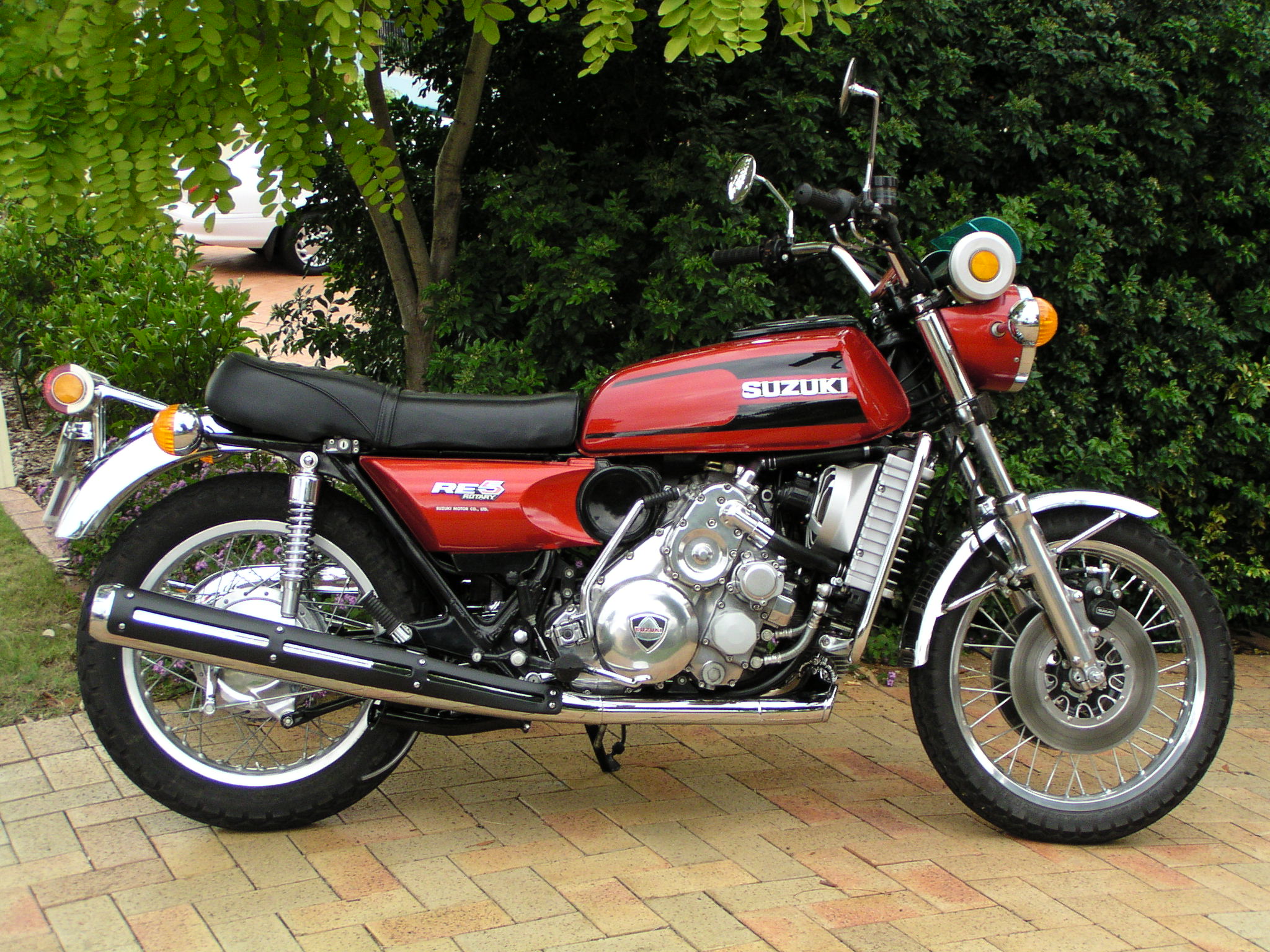 |
| Suzuki's RE-5 rotary engined motorcycle was launched in 1974. |
Even though several manufacturers gave a shot at the Rotary engine only Mazda persisted with the technology. It seems strange that it’s weak points couldn’t be fixed, in the light of its advantages. Maybe it was because that the Rotary engine didn't lend itself well to diesel fuel as well that manufacturers didn’t see any point in putting too much effort to develop the design further. However, the MAZDA site talks of the hydrogen powered rotary engine and its advantages.
Despite news of the RX8's phase out, hopeffully Mazda has plans to give this engine a new lease on life in the future.
Explanation and details gleaned from – Bosch Automotive Handbook 7th Edition, AA The Book of The Car, Wikipedia, Mazda & prelovac.com. Images from Wikimedia Commons: Gtregs75 & Softeis! Gif from prelovac.com. Many thanks! Head on over to these sites to knock yourself silly with many more details on the Wankel engine.


This comment has been removed by the author.
ReplyDeleteGod! i always loved wankel-rotary n RX-7..
ReplyDeleteGood article anyway..